A multi-core processor is a single computing component with two or more independent actual processors (called "cores"), which are the units that read and execute program instructions.[1] The data in the instruction tells the processor what to do. The instructions are very basic things like reading data from memory or sending data to the user display, but they are processed so rapidly that human perception experiences the results as the smooth operation of a program. Manufacturers typically integrate the cores onto a single integrated circuit die (known as a chip multiprocessor or CMP), or onto multiple dies in a single chip package.
Processors were originally developed with only one core. A many-core processor is a multi-core processor in which the number of cores is large enough that traditional multi-processor techniques are no longer efficient[citation needed] — largely because of issues with congestion in supplying instructions and data to the many processors. The many-core threshold is roughly in the range of several tens of cores; above this threshold network on chip technology is advantageous.Tilera processors feature a switch in each core to route data through an on-chip mesh network to lessen the data congestion, enabling their core count to scale up to 100 cores.
A dual-core processor has two cores (e.g. AMD Phenom II X2, Intel Core Duo), a quad-core processor contains four cores (e.g. AMD Phenom II X4, the Intel 2010 core line that includes three levels of quad-core processors, see i3, i5, and i7 at Intel Core), and a hexa-core processor contains six cores (e.g. AMD Phenom II X6, Intel Core i7 Extreme Edition 980X). A multi-core processor implements multiprocessing in a single physical package. Designers may couple cores in a multi-core device tightly or loosely. For example, cores may or may not share caches, and they may implement message passing or shared memory inter-core communication methods. Common network topologies to interconnect cores include bus, ring, two-dimensional mesh, and crossbar. Homogeneous multi-core systems include only identical cores, heterogeneous multi-core systems have cores which are not identical. Just as with single-processor systems, cores in multi-core systems may implement architectures such as superscalar, VLIW, vector processing, SIMD, or multithreading.
Multi-core processors are widely used across many application domains including general-purpose, embedded, network, digital signal processing (DSP), and graphics.
The improvement in performance gained by the use of a multi-core processor depends very much on the software algorithms used and their implementation. In particular, possible gains are limited by the fraction of the software that can be parallelized to run on multiple cores simultaneously; this effect is described by Amdahl's law. In the best case, so-called embarrassingly parallel problems may realize speedup factors near the number of cores, or even more if the problem is split up enough to fit within each core's cache(s), avoiding use of much slower main system memory. Most applications, however, are not accelerated so much unless programmers invest a prohibitive amount of effort in re-factoring the whole problem[2]. The parallelization of software is a significant ongoing topic of research.
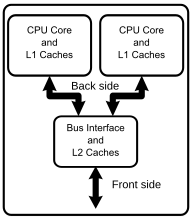

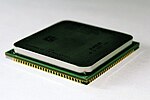
The proximity of multiple CPU cores on the same die allows the cache coherency circuitry to operate at a much higher clock-rate than is possible if the signals have to travel off-chip. Combining equivalent CPUs on a single die significantly improves the performance of cache snoop (alternative: Bus snooping) operations. Put simply, this means that signals between different CPUs travel shorter distances, and therefore those signals degrade less. These higher-quality signals allow more data to be sent in a given time period, since individual signals can be shorter and do not need to be repeated as often.
The largest boost in performance will likely be noticed in improved response-time while running CPU-intensive processes, like antivirus scans, ripping/burning media (requiring file conversion), or file searching. For example, if the automatic virus-scan runs while a movie is being watched, the application running the movie is far less likely to be starved of processor power, as the antivirus program will be assigned to a different processor core than the one running the movie playback.
Assuming that the die can fit into the package, physically, the multi-core CPU designs require much less printed circuit board (PCB) space than do multi-chip SMP designs. Also, a dual-core processor uses slightly less power than two coupled single-core processors, principally because of the decreased power required to drive signals external to the chip. Furthermore, the cores share some circuitry, like the L2 cache and the interface to the front side bus (FSB). In terms of competing technologies for the available silicon die area, multi-core design can make use of proven CPU core library designs and produce a product with lower risk of design error than devising a new wider core-design. Also, adding more cache suffers from diminishing returns.[citation needed]
Multi-core chips also allow higher performance at lower energy. This can be a big factor in mobile devices that operate on batteries. Since each core in multi-core is generally more energy-efficient, the chip becomes more efficient than having a single large monolithic core. This allows to get higher performance with less energy. The challenge of writing parallel code clearly offsets this benefit.[4]

No comments:
Post a Comment